A chimney stands above the roof with nothing to shelter it. Rain soaks in, winter freezes it, and each freeze opens the cracks a little wider. Because almost all of that happens out of sight, an inspection is how most problems get found while they are still small.
Here are the five things we look at, from the top down.
1. The cap
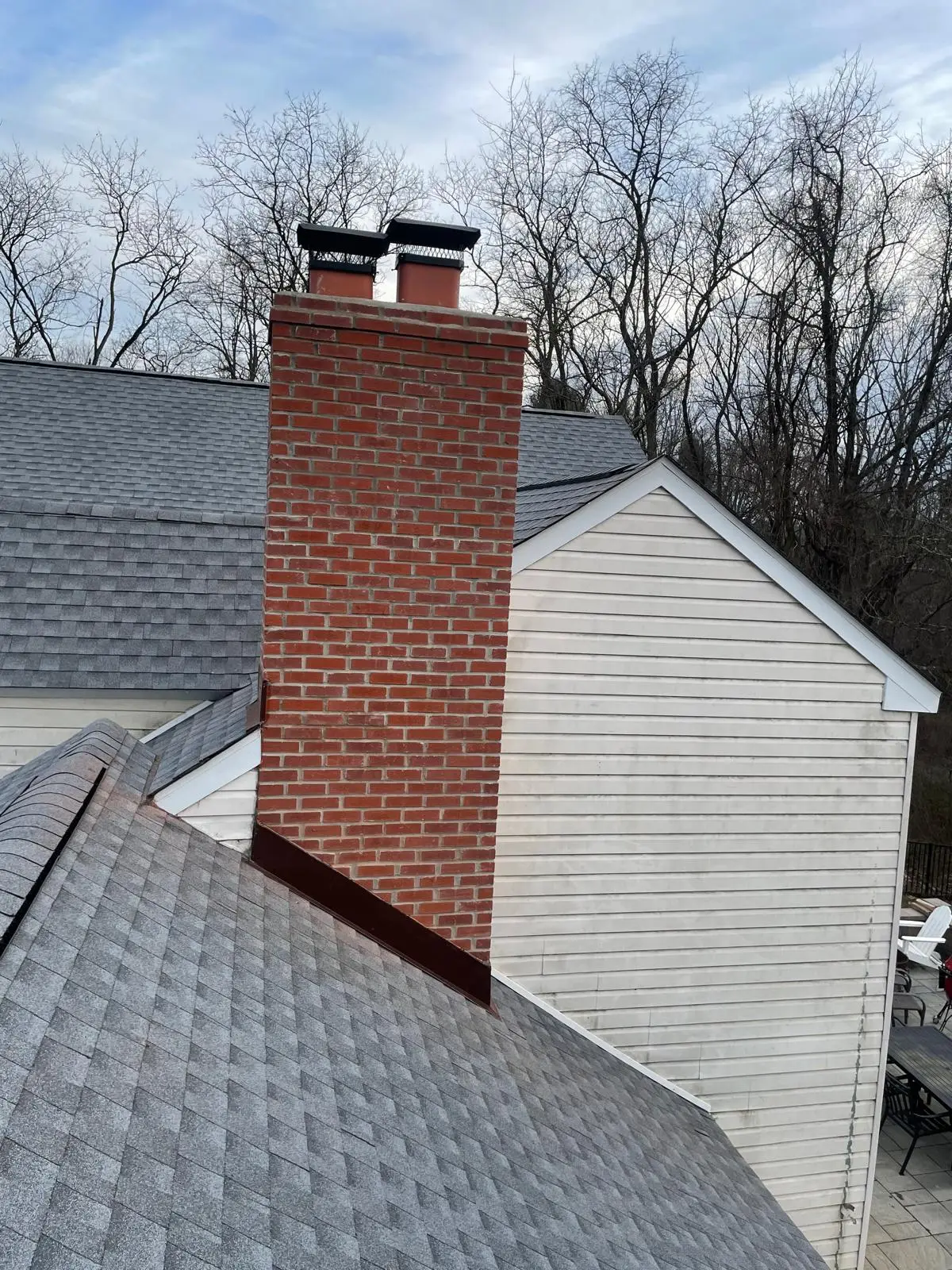
The cap is the metal cover over the flue opening. It keeps out rain, leaves and animals. Caps rust, blow off or were never fitted. A missing cap lets water straight down the flue every time it rains.
2. The crown
The crown is the sloped layer of concrete or mortar at the top of the brickwork. Its job is to shed water away from the flue. Crowns crack with age, and a cracked crown feeds water into the bricks below it. This is one of the most common things we find, and one of the cheapest to fix early.
3. Brick and mortar
We look for open or crumbling mortar joints, bricks whose faces are flaking off, and any lean in the stack. Missing mortar can be repointed. Loose and flaking bricks usually mean that section should be rebuilt.
4. The flashing
Flashing is the metal that seals the joint between the chimney and the roof. When it rusts, lifts or pulls out of the brick, water runs down the chimney into the attic and shows up as a ceiling stain. Many “roof leaks” near a chimney are really flashing leaks.
5. The liner
The liner runs inside the chimney and carries heat and exhaust out of the house. From the top we check the flue opening and what we can see of the liner. Cracked clay tiles or a missing liner are safety problems, not just maintenance ones.
When to have it done
- Before the heating season
- When you buy or sell a house
- After a severe storm
- When you connect a new furnace, boiler or water heater
- Whenever you notice loose brick, staining or a damaged cap
What happens afterwards
We tell you what we found. If something needs repair you get a free estimate, and if nothing does, we tell you that too.